How to Collect Exemption Certificates in Ohio (2026)
How Ohio sellers collect STEC-B and STEC-U exemption certificates from customers: the 90-day rule, required fields, e-certificates and audit-ready storage.
An Ohio tax auditor picks twenty of your tax-free invoices and asks for the certificate behind each one. Three customers never sent theirs, and one sent a form with no exemption reason. Under Ohio law, the tax on those sales now falls on you, the seller, along with interest.
This guide covers what Ohio requires, how to collect certificates without chasing customers by email for weeks, and how to store them so an audit takes an afternoon instead of a month.
Who Has to Collect Ohio Exemption Certificates?
If you hold an Ohio vendor's license and sell to a customer without charging sales tax, you're the one who needs proof of why. Ohio presumes every retail sale is taxable. A buyer who claims an exemption, such as resale, manufacturing, agriculture, or a nonprofit or government purchase, documents it by giving you a certificate.
The payoff for the seller is spelled out in statute: a vendor that obtains a fully completed exemption certificate "is relieved of liability for collecting and remitting tax on any sale covered by that certificate" (R.C. 5739.03(B)(1)(b)). Without the certificate, you keep the liability.
Ohio has two general forms:
| Form | Use it when | Covers |
|---|---|---|
| STEC-B (blanket) | You sell to the same exempt buyer repeatedly | All qualifying purchases from you going forward |
| STEC-U (unit) | A single exempt purchase | One sale or invoice |
For a full breakdown of each form, see our guides to the Ohio blanket exemption certificate and the Ohio sales tax exemption certificate (STEC-B and STEC-U). Resellers should also read the Ohio resale certificate guide.
The 90-Day Rule and the 120-Day Rescue Window
Ohio gives sellers a deadline, and it's shorter than most people think.
- 90 days. If no certificate is provided or obtained within 90 days after the sale, "it shall be presumed that the tax applies" (R.C. 5739.03(B)(4)).
- 120 days. Missing that deadline isn't fatal. After the Tax Commissioner gives written notice of intent to assess, you have 120 days to show the sale was not taxable, or to obtain a fully completed certificate in good faith.
Don't plan around the 120-day window. By then you're mid-audit, the customer may have moved on, and "good faith" gets harder to show for a sale that is two or three years old.
Practical rule: treat 30 days as your internal deadline. Any tax-free sale without a certificate at 30 days gets a follow-up. Anything still missing at 60 days goes to the owner or controller.
What a Valid Ohio Certificate Must Contain
The Ohio STEC-B form asks for:
- Vendor's name: your business, the seller.
- Exemption reason: the specific basis, for example "sale for resale" under R.C. 5739.01(E)(1).
- Purchaser's name and type of business.
- Purchaser's street address and city, state, ZIP.
- Signature and title on paper forms.
- Date signed.
- Purchaser's vendor's license number, if applicable (typical for resellers).
Two details trip sellers up:
- The reason must match the purchase. A resale certificate from a restaurant covers food it resells, not the new walk-in cooler.
- Electronic certificates don't need a signature. The Ohio Department of Taxation's exemption certificate page (ST 2005-02, revised April 2025) states that no signature is required on electronic certificates. You can therefore collect certificates through an online form instead of chasing wet-ink PDFs.
You can produce a blank or pre-filled form with our free Ohio exemption certificate generator.
A Five-Step Collection Workflow That Holds Up in an Audit
Step 1: Ask at onboarding, not at invoicing
Make the certificate part of opening a wholesale or tax-exempt account. Sales reps should not mark an account tax-exempt until the certificate is on file. This one rule prevents most missing-certificate findings.
Step 2: Send customers a link, not a blank PDF
The traditional process goes like this. You email a blank STEC-B, the customer prints it, fills it in, signs it, scans it, and emails it back, and you save it somewhere. Each handoff is a chance for the form to stall.
An online request link is faster. The customer opens it on a phone or laptop, fills in the fields, and submits. Because Ohio doesn't require a signature on electronic certificates, the form is complete the moment it's submitted.
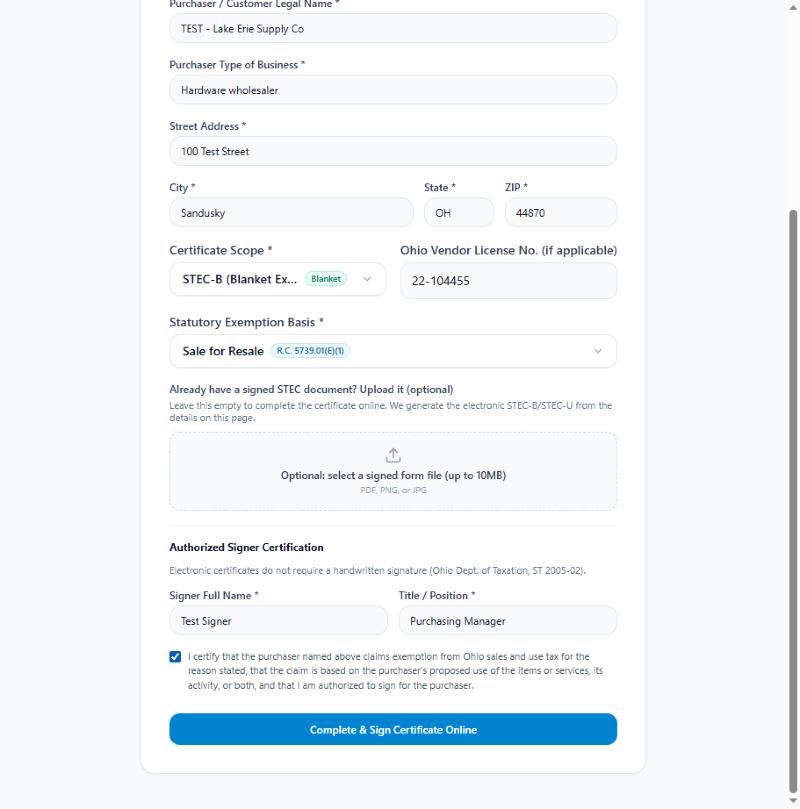
The customer-facing request form in Ohio Sales Tax Pro. Buyers fill in the STEC-B fields online or upload a signed copy, and the certificate lands in the seller's vault.
Step 3: Review every certificate before you rely on it
Check each incoming certificate for:
- every required field filled in;
- a reason that matches what the customer actually buys from you;
- a legal name that matches your customer record and invoices.
Mark it "reviewed" only after a person has looked at it.
Step 4: Store certificates by customer, with the sales they cover
When an auditor samples an invoice, you need to go from the invoice to the customer to the certificate in seconds. Spreadsheet trackers break here: the file sits in one folder, the tracker in another, and nobody updated the tracker when the customer changed its name.
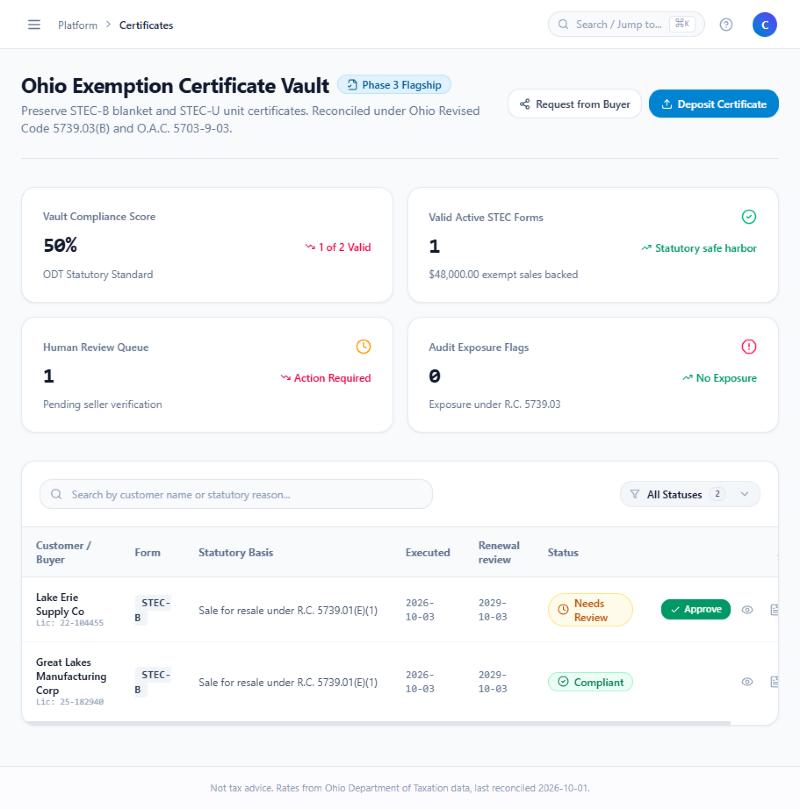
A certificate vault keeps the form, the review status, the customer's vendor license number, and the dollar value of exempt sales it backs in one record.
Step 5: Keep four years, then review
Ohio requires vendors to keep exemption certificates with their sales records for four years, unless the Tax Commissioner allows earlier destruction in writing or orders them kept longer (R.C. 5739.11). That matches the general four-year limit on sales tax assessments in R.C. 5739.16.
Ohio sets no fixed expiration date for a blanket certificate. Still, put each one on a review cycle. When a customer reorganizes (sole proprietor to LLC, new name, new address), collect a fresh certificate.
What an Auditor Will Ask For
When the Ohio Department of Taxation audits sales tax, exempt sales get extra attention. Expect to produce:
- a list of exempt sales for the audit period;
- the certificate supporting each one;
- an explanation for any exempt sale without a certificate.
Sellers who can hand over that package on day one usually see a shorter, narrower audit. Our Ohio sales tax audit guide walks through the full process.
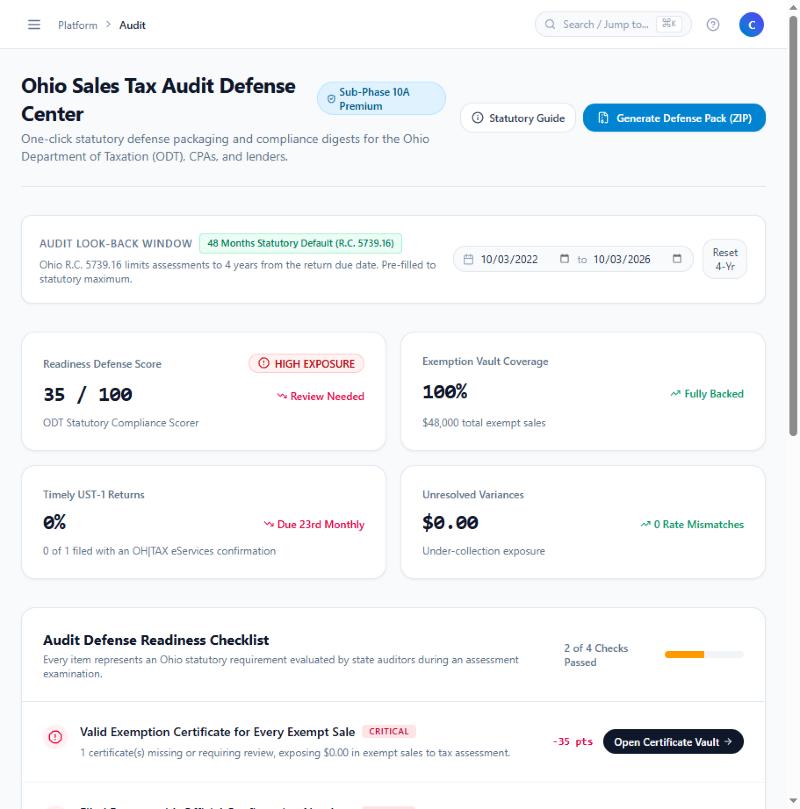
An audit readiness view flags exempt sales that have no certificate and bundles certificates, a certificate index and a rate history into one download for the auditor.
Spreadsheet vs. Certificate Software: When to Switch
A shared folder and a spreadsheet work when you have a handful of exempt customers. Consider dedicated tools when any of these is true:
- you have more than 20–30 exempt customers, or new ones every month;
- more than one person grants tax-exempt status on accounts;
- you've had an audit finding for a missing certificate before;
- your exempt sales are a large share of revenue (wholesale, distribution, B2B manufacturing supply).
National tools like Avalara's certificate products are built for multistate sellers and priced accordingly. If your business is Ohio-only, Ohio Sales Tax Pro's certificate tracker is built around the STEC-B and STEC-U forms:
- online request links;
- electronic certificates;
- a review queue;
- a four-year audit pack.
For a broader comparison of approaches, see exemption certificate management for small businesses.
Frequently Asked Questions
How do I collect exemption certificates from customers in Ohio? Ask for the certificate before or at the first exempt sale, using Ohio Form STEC-B for ongoing purchases or STEC-U for a single purchase. Check that every required field is filled in, store the certificate where you can retrieve it by customer, and follow up on any exempt sale that still has no certificate well inside the 90-day window in R.C. 5739.03(B)(4).
What happens if a customer never sends an exemption certificate? If no certificate is provided or obtained within 90 days after the sale, Ohio law presumes the sale was taxable (R.C. 5739.03(B)(4)). A vendor still gets 120 days after the Tax Commissioner's written notice of intent to assess to prove the sale was exempt or obtain a fully completed certificate in good faith.
Does an Ohio exemption certificate need a handwritten signature? Not when it is electronic. The Ohio Department of Taxation's exemption certificate guidance (information release ST 2005-02, revised April 2025) states that no signature is required on electronic certificates. Paper certificates still carry a signature line.
Do Ohio blanket exemption certificates expire? Ohio does not set a fixed calendar expiration date for a blanket certificate. Many sellers still review blanket certificates on a schedule, because a change in the buyer's legal name, address, or exemption reason means you need a new one.
How long do I have to keep exemption certificates in Ohio? R.C. 5739.11 requires vendors to keep exemption certificates with their sales records for four years, unless the Tax Commissioner consents in writing to earlier destruction or orders them kept longer.
What makes an Ohio exemption certificate invalid? A certificate is weak or invalid when required fields are missing (purchaser name, address, type of business, exemption reason, date), when the reason does not fit what the buyer purchased, or when you accept it knowing the claim is false. A vendor that obtains a fully completed certificate is relieved of liability for the tax on the covered sales (R.C. 5739.03(B)(1)(b)).
Stop Chasing PDFs
Ohio Sales Tax Pro lets you:
- send customers a secure request link;
- receive completed electronic STEC-B or STEC-U certificates;
- review them in one queue;
- export a four-year audit pack in one click.
It's built only for Ohio, so the forms, rules and deadlines match what Ohio auditors check. Create your free account or see how the certificate tracker works.
Sources & Statutory Citations
- Ohio Revised Code 5739.03: exemption certificates, vendor relief, the 90-day presumption and the 120-day window
- Ohio Revised Code 5739.11: four-year record and certificate retention
- Ohio Revised Code 5739.16: four-year limit on assessments
- Ohio Revised Code 5739.01: definitions, including sale for resale in division (E)(1)
- Ohio Department of Taxation, Exemption Certificate Forms (ST 2005-02, revised April 2025)
Ready to run the numbers?
Get your result instantly — private, in your browser.
Cite & Attribute This Resource
Ohio CPA & Small Business Advisor. (2026). "How to Collect Exemption Certificates in Ohio (2026)". Verified against Ohio Department of Taxation records. Retrieved from https://www.ohiosalestaxcalculator.com/blog/collect-exemption-certificates-from-customers-ohio
Permitted for quotation and attribution in professional, journalistic, legal, and academic works.
About the author
Researched, authored, and audited by our dedicated Ohio sales tax research team. Every county tax rate, municipal transit levy, statutory exemption rule (R.C. 5739), and UST-1 return schedule is audited directly against official Ohio Department of Taxation reports and the Ohio Revised Code.